Most living room lighting problems are not taste problems — they are diagnosis problems. The room feels “off,” but nothing tells you why. Below are the five symptoms that account for almost every unhappy living room we hear about, what causes each one, and the fix.
Symptom 1: It feels like an operating theater
The cause: one bright ceiling fixture doing all the work. A single central source flattens the room — bright above, dim at the edges, no shadows to give the space depth.
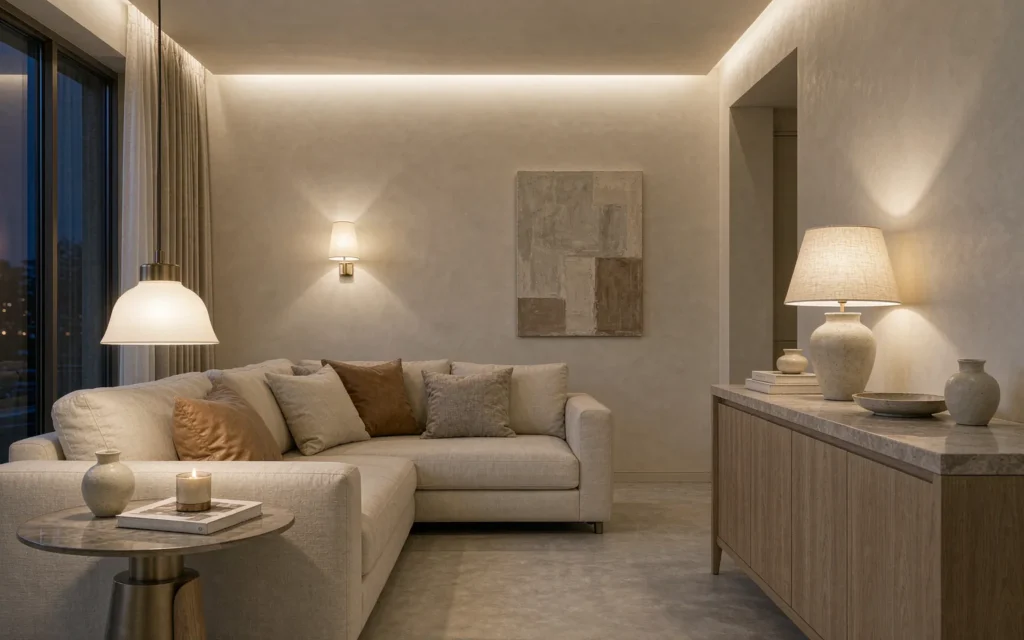
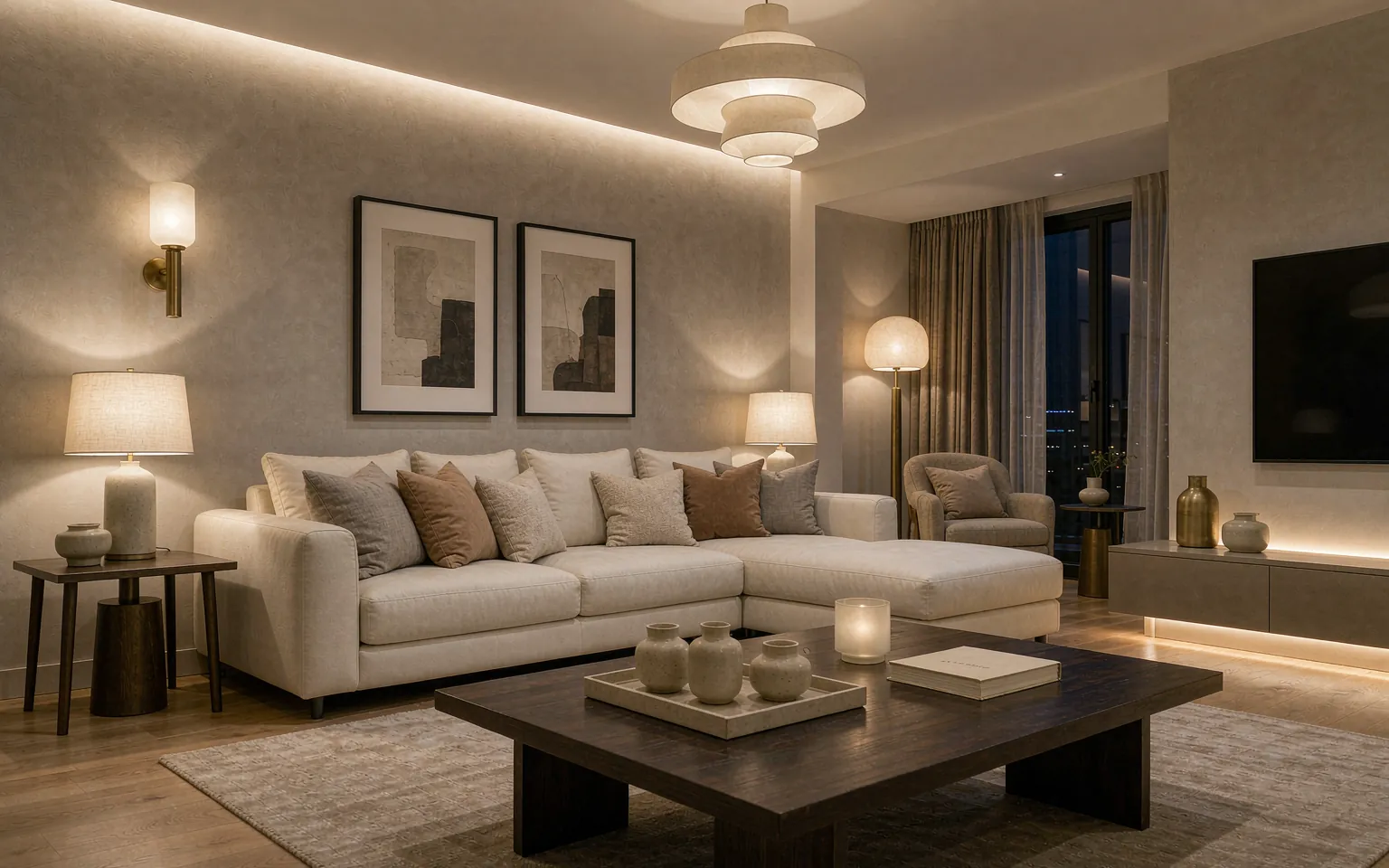
The fix: add mid-height light. Two table lamps on opposite sides of the room, or one lamp plus a pair of wall lights, breaks the flatness immediately. Then put the ceiling light on a dimmer and treat it as the brightest layer, not the only one.
Symptom 2: It’s gloomy even with everything on
The cause: not enough total output. Living rooms need roughly 20 lumens per square foot — a 15-by-18-foot room wants around 5,000 lumens, and a single modest ceiling fixture often supplies only a third of that.
The fix: count what you actually have. Add the lumen ratings on your bulbs across all fixtures; if you are far short, add sources rather than hunting for a brighter bulb — two or three distributed fixtures beat one blazing one every time. The layering logic is in our fixture types guide.
Symptom 3: The light feels cold and clinical
The cause: color temperature. Bulbs at 4000K and above read like an office, no matter how nice the fixtures are. It is the most common single mistake and the cheapest to fix.
The fix: 2700K–3000K everywhere in the living room, and the same range in adjoining spaces so the rooms don’t clash. Our color temperature cheat sheet walks through every room.
Symptom 4: The room has no center of gravity
The cause: all light is ambient, nothing is anchored. A living room with only downlights or diffuse glow has no place that draws the eye — and no place for the eye to rest.
The fix: one deliberate focal light. Over the coffee table, above the sofa, or in a reading corner — a pendant, a sculptural ceiling piece, or an arc lamp that owns its corner. It does not need to be the brightest thing in the room, just the most intentional.
Symptom 5: You can see the bulbs
The cause: glare. Exposed bulbs and open shades at eye level force you to squint, and the room subconsciously reads as uncomfortable no matter how well it is lit.
The fix: keep bare-bulb fixtures above seated eye level (this is what the 7-foot rule protects), and choose shaded or diffused pieces for anything at lamp height. Where you want visible bulbs, frosted glass takes the edge off without losing the look.
A living room done right passes the squint test: you can look anywhere in the room without ever looking directly into a light source.
The 10-minute diagnosis
| If your room feels… | Check first | Typical fix |
|---|---|---|
| Flat and bright | How many sources at lamp height? | Add two lamps or sconces, dim the ceiling |
| Gloomy overall | Total lumens vs 20/sq ft | Add a fixture or two, not brighter bulbs |
| Cold and sterile | Kelvin rating on the bulbs | Swap everything to 2700K–3000K |
| Boring, no anchor | Is there one intentional focal light? | Pendant or statement piece at the center |
| Uncomfortable to sit in | Visible bulbs at eye level | Shades, diffusers, or raise the fixture |
Frequently asked questions
Should the ceiling light be the brightest thing in the room?
It can be, but it should never feel like it. If the ceiling fixture dominates, dim it — layered rooms read as brighter overall than single-source rooms even at lower wattage.
Where should lamps go in a living room?
Spread diagonally: one near the seating, one across the room. Diagonal placement distributes light evenly and avoids the “half the room is lit” effect.
How do I fix lighting in a rental without wiring anything?
Plug-in sources carry almost the whole job: table lamps, floor lamps, and plug-in wall lights. Swap bulbs to 2700K dimmable, and the room changes character in an afternoon.
If your living room’s proportions fight every standard fixture, our custom lighting service builds to your dimensions — or contact us with photos and measurements.