The quick answer
Most height mistakes come from guessing, so start with the two rules that cover almost every room in the house. Over a dining table, kitchen island or counter, hang the bottom of the fixture 30 to 36 inches (76 to 91 cm) above the surface. In any open area people walk through — foyers, hallways, living rooms, stair landings — keep the bottom at least 7 feet (2.1 m) above the floor.
Everything else is a variation on those two rules. Here is the full cheat sheet:
| Placement | Recommended height |
|---|---|
| Above a dining table | 30–36 in (76–91 cm) above the tabletop |
| Above a kitchen island or counter | 30–36 in (76–91 cm) above the surface |
| Open foyer, hallway, living room | Bottom at least 7 ft (2.1 m) above the floor |
| Two-story foyer | Bottom roughly level with the second floor |
| Above a coffee table | About 30–34 in above the tabletop (nobody walks under it) |
| Bedroom, general | About 7 ft above the floor |
| Above nightstands | Low enough to read by, clear of sitting height |
| Stairwell | High enough to clear headroom along the stair path |
If you are still deciding on the fixture itself, our chandelier size guide covers the width and diameter side of the equation — height and size work together.
Over the dining table: 30 to 36 inches
The dining table is the most common place a chandelier or pendant ends up too high. When the fixture floats far above the table, it stops framing the conversation area and the room starts to feel like a hotel lobby.
- Start at 30 inches above the tabletop on a standard 8-foot ceiling. If everyone at the table can see each other comfortably and the light does not block sightlines across the table, you are close.
- Go up to 36 inches if you have tall family members, a lively kitchen-dining traffic path, or an open-plan space where the table is visible from the entrance.
- Add roughly 3 inches per extra foot of ceiling. A 10-foot ceiling can carry the fixture 6 inches higher than the baseline without losing intimacy.
Quick self-check: stand at the far end of the table. If the fixture blocks your view of a person seated across from you, it is too low. If it feels like a ceiling fan in disguise, it is too high.
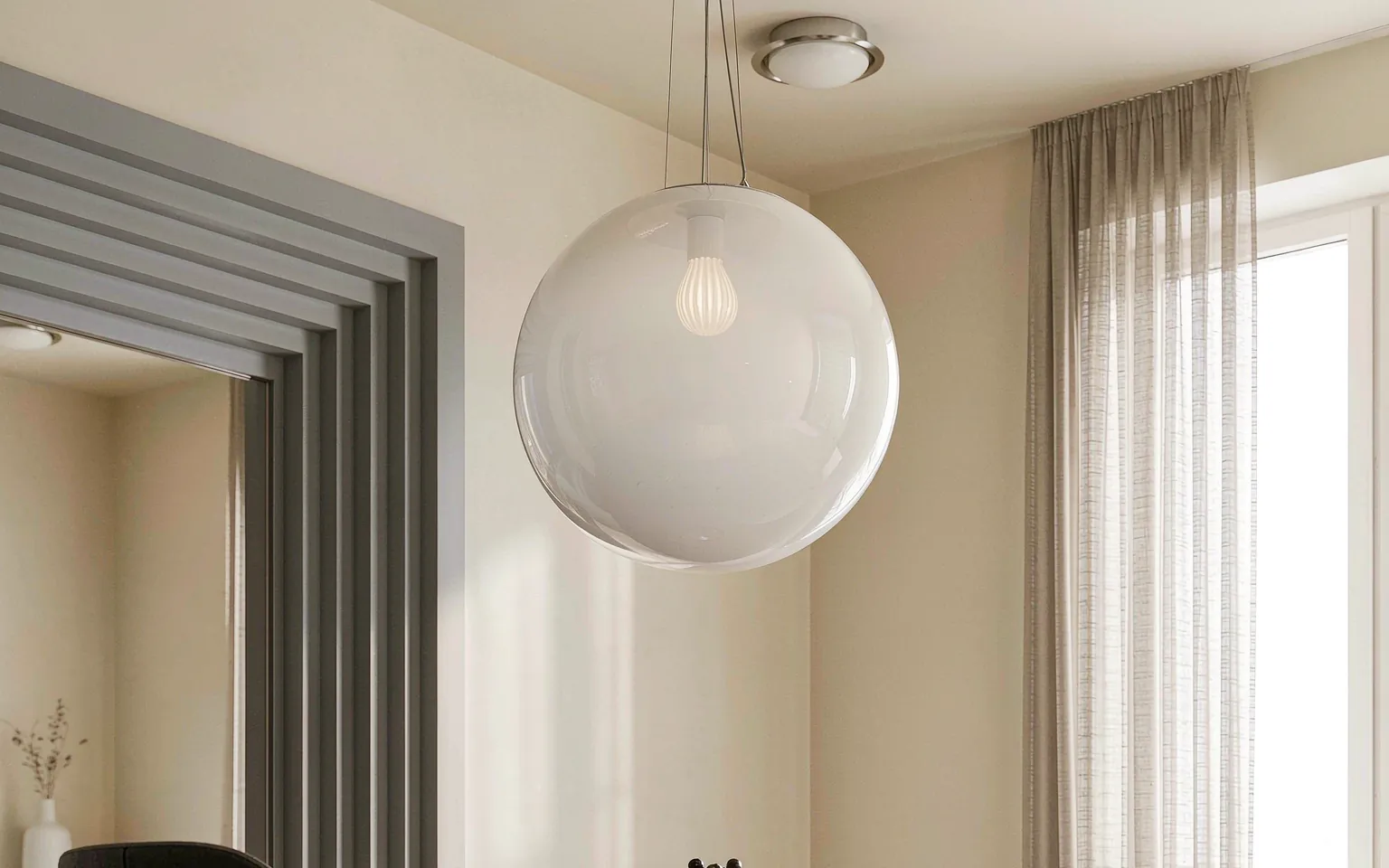
Round tables and globe pendants work especially well together because the symmetry echoes the tabletop — you can see how our pendant lights behave over different table shapes in the product photos.
Kitchen islands and counters
The same 30–36 inch rule applies above islands and counters. Two practical differences:
- Linear arrangements beat single fixtures. Two or three pendants spread across a long island light the work surface more evenly than one wide chandelier, and they look intentional rather than accidental.
- Mind the sightline to the living room. In open-plan homes, the island is visible from the sofa. Pendants that sit below eye level from the seated position feel right from both sides.
Foyers, hallways and living rooms: the 7-foot rule
Anywhere people walk underneath, the bottom of the fixture needs at least 7 feet (2.1 m) of clearance. That keeps tall guests safe and keeps the fixture above the “visual traffic” of the room.
Two common situations deserve extra attention:
- Two-story foyers: hang the chandelier so its bottom sits roughly level with the second floor. If it hugs the first-floor ceiling, it disappears when viewed from the landing; if it hangs too deep into the first floor, it obstructs the entry path.
- Stairwells: measure headroom along the stair path, not from the floor directly below the ceiling opening. The lowest point of the fixture should clear the tallest person walking up the stairs with a comfortable margin.
Bedrooms
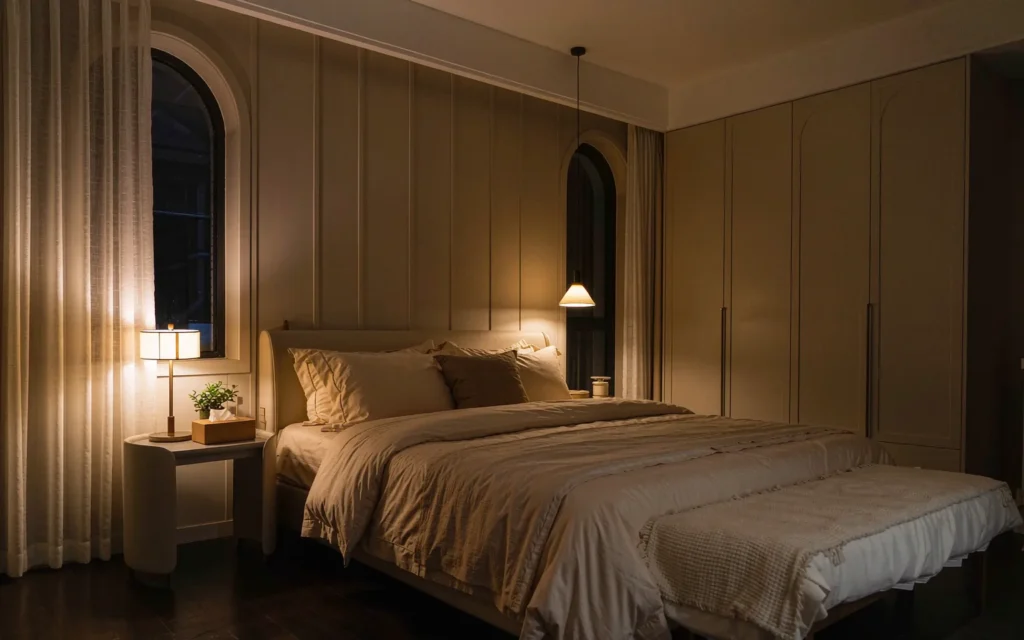
A bedroom chandelier centered in the ceiling should follow the 7-foot rule. If the fixture sits over the bed itself, you can bring it lower — the bed is the one “table” you never walk under — but keep it high enough to sit up comfortably. Wall lights or pendants beside or above the nightstands are worth considering too: they free up the nightstand surface and give you a reading light exactly where you need it. Our wall lights collection is built around that use case.
Adjusting for ceiling height
Ceiling height changes everything above a surface. The working rule: add about 3 inches of height for every extra foot of ceiling above 8 feet, and subtract a little for ceilings below 8 feet. A 7-foot ceiling over a dining table may need the fixture at 28–30 inches; a 12-foot ceiling can carry it 12 inches higher than the baseline.
Vaulted and sloped ceilings are the exception: hang the fixture relative to the floor and the furniture, not the ceiling plane, and choose a fixture with an adjustable rod, chain or sloped-ceiling canopy.
Frequently asked questions
Can a chandelier be too high?
Yes, and it is the most common mistake. A fixture hung above eye level in a void stops being a design element and becomes a ceiling ornament. Over tables, stay in the 30–36 inch band; in open rooms, resist hanging above the minimum 7 feet by much.
What if the fixture comes with a fixed rod length?
Many fixtures offer extenders or interchangeable rods. Check before buying if your ceiling is unusual — or consider custom lighting, where the suspension length can be made to your exact ceiling.
How high should pendants hang beside a bed?
Around the height of the top of the headboard, or slightly above, so the light lands on your book rather than your eyes. Leave at least a hand’s width between the shade and your seated head height.
Does bulb choice change the perceived height?
Indirectly. Exposed-bulb and open-globe designs draw the eye upward and read “airier” at the same height, while shades and crystals read heavier and more present. When in doubt, hang heavier-looking designs slightly higher within the recommended band.