Start with the anchor: the fixture over the table
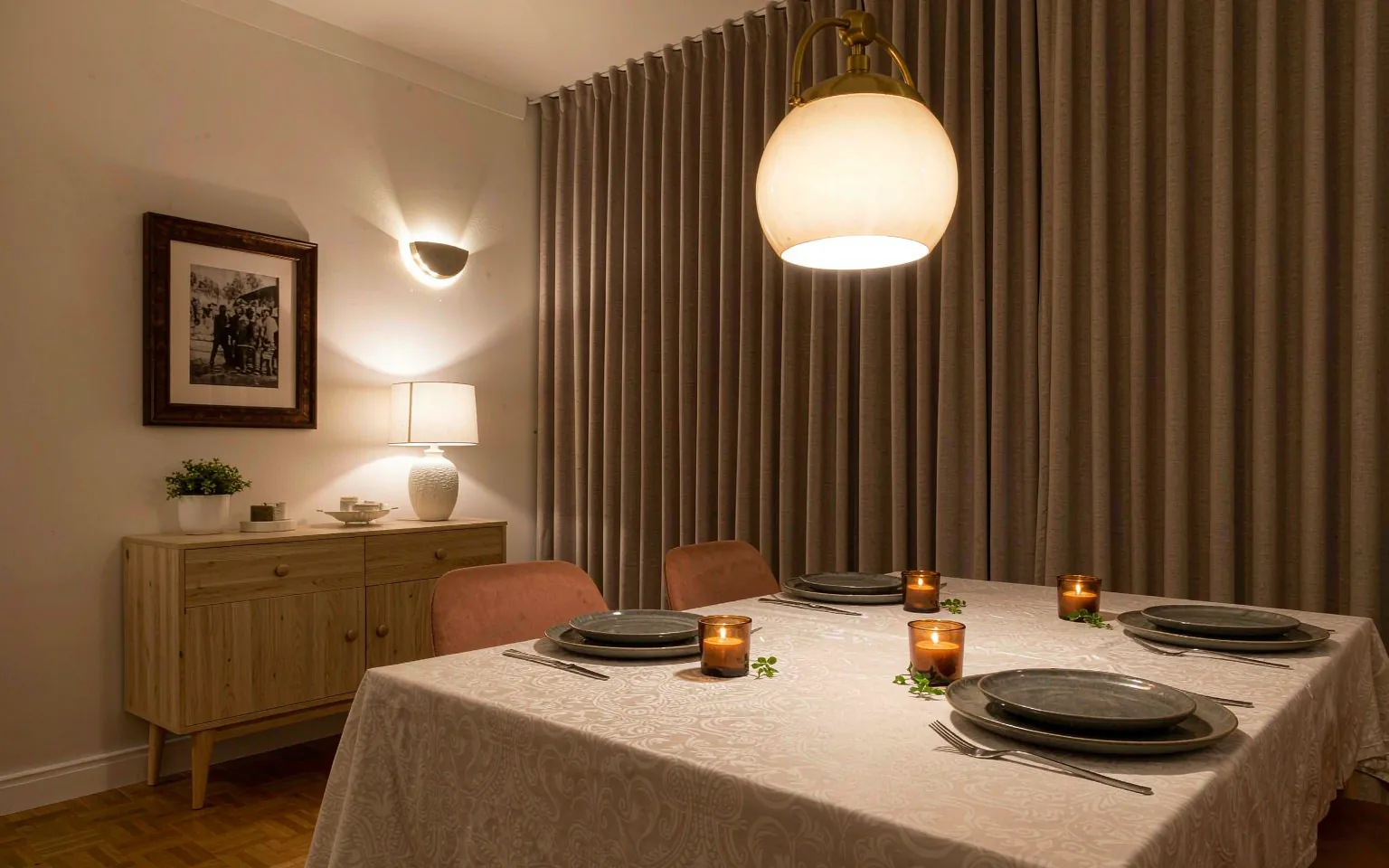
In most dining rooms, one fixture above the table does the heavy lifting. It defines the zone, centers the conversation and carries the room’s style. Before thinking about anything else, get two numbers right: the fixture should be 30–36 inches above the tabletop, and its width should relate to the table — roughly one-half to two-thirds of the table’s width. If you want the full formulas, our chandelier size guide and hanging height guide cover both.
Once the anchor is right, the rest of the room becomes much easier: you are no longer lighting a whole room from one ceiling point, you are building layers around a finished center.
Match the fixture shape to the table shape
The fastest way to make a dining room feel “off” is a shape mismatch between fixture and table:
- Rectangular tables suit linear chandeliers or a row of two or three pendants running the length of the table. Keep the fixtures centered on the table, not the room — in many dining rooms these are not the same point.
- Round tables flatter round and globe silhouettes. A single centered pendant echoes the tabletop and keeps the sightline between seated guests clear.
- Square tables handle either a single centered globe or a tight two-pendant pair, depending on size.
Our pendant lights include globe, cluster and linear silhouettes that map directly onto these table shapes.
Layer two: soften the room with perimeter light
A single overhead source makes everything under it bright and everything else dim — the “stage lighting” effect. The fix is a second layer at a lower height:
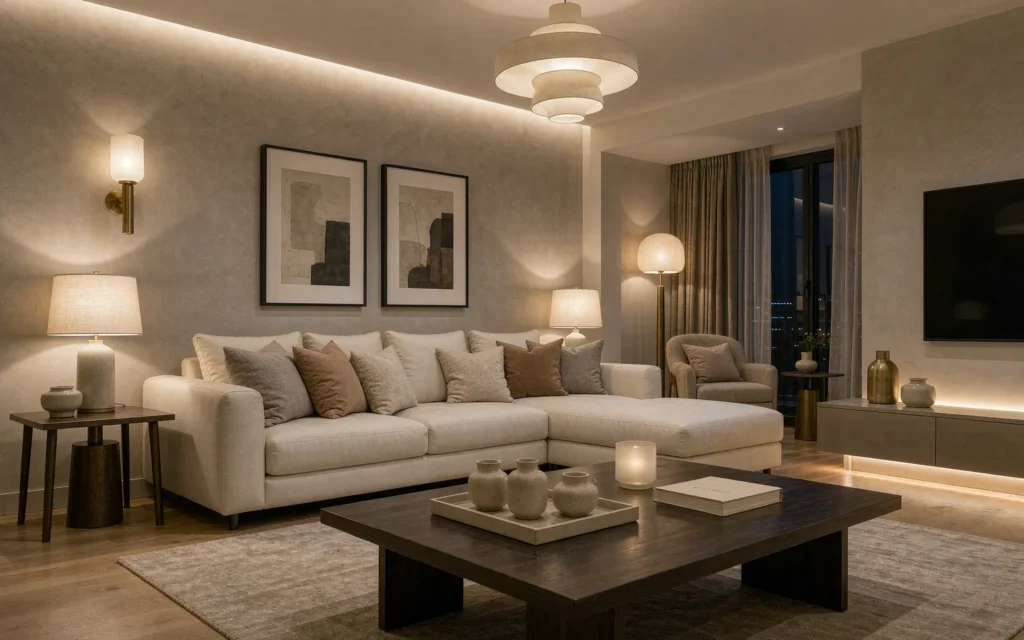
- Wall lights on the wall behind or beside the table add gentle vertical light and make the room feel finished in the evening. Two sconces flanking a sideboard or artwork is a classic, low-effort placement — see our wall lights.
- Table lamps on a sideboard or buffet add mid-height warmth and keep the room usable after dinner without the full overhead brightness. Our table lamps cover this role.
Layer three: the light you barely notice
If your dining room has a ceiling fixture plus perimeter lamps, you already have ambient and accent covered. The last layer is directional light where the room needs it — a picture light over artwork, a sconce aimed at a mirror to double the sense of space, or a ceiling light in the transition between dining and kitchen in open-plan rooms.
The test of good dining room lighting: you can read a menu, see the people across the table, and still feel the room get cozier when the sun goes down.
Color temperature and dimming: the two settings that matter
Fixture choice gets the attention, but two lighting settings decide how the room actually feels at 7 p.m.:
- Stay warm. 2700K–3000K (warm white) is the range for dining rooms. Anything above 3500K starts to read clinical, like a clinic rather than a dinner party.
- Install a dimmer. The chandelier at full output is for homework and cleaning; dimmed to 30–40% it becomes the dinner setting. If you buy a fixture with an integrated LED, confirm it is dimmable and pair it with a compatible dimmer.
Small dining spaces and breakfast nooks
Small tables work exactly like big ones, just scaled down. A single pendant centered over a two- or four-seat table, hung at the same 30–36 inch height, does more for a nook than scattered downlights. If the nook sits by a window, choose a fixture that looks good in daylight too — it will be the visual anchor of the corner whether it is on or off.
Frequently asked questions
How bright should a dining chandelier be?
Aim for roughly 20–30 lumens per square foot of dining area from all sources combined. A typical chandelier provides 1,500–3,000 lumens, which is why perimeter lamps and dimmers do the fine-tuning rather than one oversized fixture.
Can I hang multiple pendants over one table?
Yes — two or three smaller pendants in a row over a long table often look better than one wide fixture. Space them evenly along the table’s centerline, keep the lowest parts level, and aim for the combined width to stay within the table’s length.
My dining room is part of an open-plan space. What changes?
Treat the table as its own zone: center the fixture over the table, not the room, and use the perimeter layers to visually separate dining from living. Consistent color temperature across the whole open space (2700K–3000K) keeps the zones feeling connected.
What if I cannot find the right fixture for my space?
Unusual ceiling heights, long tables and awkward room proportions are exactly what our custom lighting service exists for. If something between our standard pieces and your room does not line up, contact us with your dimensions and photos.